ISLES’24: Final Infarct Prediction with Multimodal Imaging and Clinical Data. Where Do We Stand?
Jul 7, 2025·,,,,,,,,,,,,,,,,,,,,,,,,,,,,,,,,,,,,,,,·
0 min read
Ezequiel De La Rosa
Ruisheng Su
Mauricio Reyes
Evamaria O. Riedel
Hakim Baazaoui
Roland Wiest
Florian Kofler
Kaiyuan Yang
David Robben
Mahsa Mojtahedi
Laura Van Poppel
Lucas De Vries
Anthony Winder
Kimberly Amador
Nils D. Forkert
Gyeongyeon Hwang
Jiwoo Song
Dohyun Kim
Eneko Uruñuela
Annabella Bregazzi
Matthias Wilms
Hyun Yang
Jin Tae Kwak
Sumin Jung
Luan Matheus Trindade Dalmazo
Kumaradevan Punithakumar
Moona Mazher
Abdul Qayyum
Steven Niederer
Jacob Idoko
Mariana Bento
Gouri Ginde
Tianyi Ren
Juampablo Heras Rivera
Mehmet Kurt
Carole Frindel
Susanne Wegener
Jan S. Kirschke
Benedikt Wiestler
Bjoern Menze
Abstract
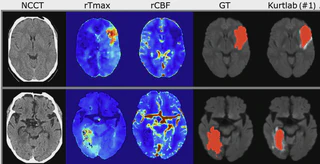
Accurate estimation of brain infarction (i.e., irreversibly damaged tissue) is critical for guiding treatment decisions in acute ischemic stroke. This work introduces the ISLES’24 challenge, which focuses on the prediction of final infarct volumes from pre-interventional acute stroke imaging and clinical data. The challenge provides a comprehensive multimodal dataset—including full acute CT imaging, follow-up MRI, and structured clinical information—for 150 training and 98 test cases. On the hidden test set, the top-performing multimodal nnU-Net–based model achieved a Dice score of 0.285 ± 0.213 and an absolute volume difference of 21.2 ± 37.2 mL, underlining the difficulty of the task and the need for further advances. ISLES’24 establishes a standardized benchmark for post-treatment infarct prediction and highlights current methodological limitations, offering guidance for the development of next-generation multimodal models.
Type
Publication
arXiv preprint arXiv:2408.10966